Gold History
GOLD HISTORY
Gold, a dense lustrous yellow precious metal, a chemical element of Group 11, period 6 of the periodic table, Au has qualities that made it very valuable throughout the history. It’s attractive in colour, durable, a good heat and electricity conductor, soft, highly malleable and found in nature in a comparatively pure form. Being visually pleasing and workable and does not tarnish or corrode, it was one of the first metals to attract human attention and continues to be a highly favoured material for crafting jewellery and other decorative objects.
Because of its unique qualities, gold has been the one material that is universally accepted in exchange for goods and services. In the form of coins or bullion, gold has occasionally played a major role as a high-denomination currency, although silver was generally the standard medium of payments in the world’s trading systems. Gold began to serve as backing for paper-currency systems when they became widespread in the 19th century, and from the 1870s until World War I the gold standard was the basis for the world’s currencies. Although gold’s official role in the international monetary system had come to an end by the 1970s, the metal remains a highly regarded reserve asset, and approximately 45 percent of all the world’s gold is held by governments and central banks for this purpose.
Gold is widespread in low concentrations in all igneous rocks and occurs mostly in the native state, remaining chemically un-combined except with tellurium, selenium, and bismuth. Gold often occurs in association with copper and lead deposits, and, though the quantity present is often extremely small, it is readily recovered as a by-product in the refining of those base metals.
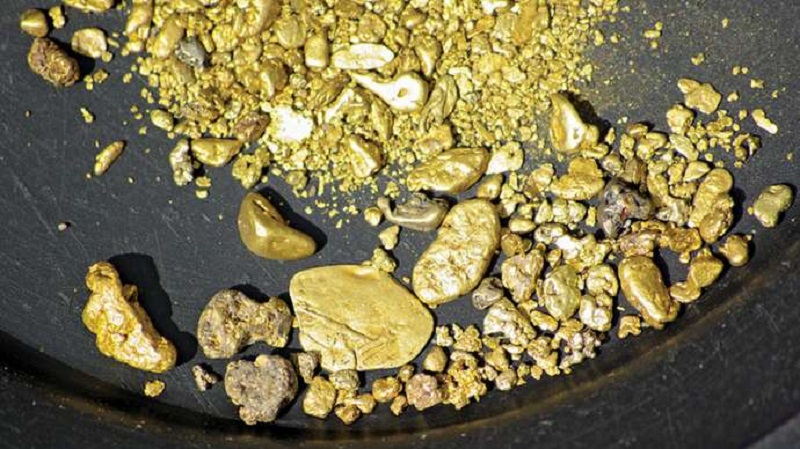
Gold in rocks usually occurs as invisible disseminated grains, more rarely as flakes large enough to be seen, and even more rarely as masses or veinlets. Crystals have been found in California and masses, some on the order of 90 kg have been reported from Australia.
Alluvial deposits of gold found in or along streams were the principal sources of the metal for ancient Egypt, Mesopotamia, Lydia, the lands of the Aegean, Persia, India, China and other lands. The era of gold production that followed the Spanish discovery of the Americas in the 1490s was probably the greatest the world had witnessed to that time.
From Christopher Columbus’s discovery of the New World in 1492 to 1600, more than 225,000 kg of gold, or 35 percent of world production, came from The New World’s mines, especially those in Colombia, continued into the 17th and 18th centuries to account for 61 and 80 percent, respectively, of world production. 1,350,000 kg were mined in the 18th century.
Russia became the world’s leading producer of gold in 1823, and for 14 years it contributed the bulk of the world supply. During the second era of expanding production (1850–75), more gold was produced in the world than in all the years since 1492, primarily because of discoveries in California and Australia. A major factor in the increase of the world’s supply of gold was the introduction in 1890 of the cyanide process for the recovery of gold from low-grade ores and ores containing minute, particle-sized gold.
Gold production continued to rise throughout the 20th century, partly because of the improvement in recovery methods and partly because of the continual growth and expansion of South Africa’s gold-mining operations.
In the late 20th century, four countries, South Africa, Russia, the United States and Australia accounted for two-thirds of the gold produced annually throughout the world. In the early 21st century, China was the world leader in gold production. During this period, Australia, the United States, Russia, Canada, and South Africa also continued to supply large amounts of the precious metal.
Because pure gold is too soft to resist prolonged handling, it is usually alloyed with other metals to increase its hardness for use in jewellery, goldware, or coinage. Most gold used in jewellery is alloyed with silver, copper, and a little zinc to produce various shades of yellow gold or with nickel, copper, and zinc to produce white gold.
Because of its high electrical conductivity (71 percent that of copper) and inertness, the largest industrial use of gold is in the electric and electronics industry for plating contacts, terminals, printed circuits, and semiconductor systems. Thin films of gold that reflect up to 98 percent of incident infrared radiation have been employed on satellites to control temperature and on space-suit visors to afford protection. Used in a similar way on the windows of large office buildings, gold reduces the air-conditioning requirement and adds to the beauty.
Gold has also long been used for fillings and other repairs to teeth and is one of the noblest, that is, least chemically reactive of the transition elements.
For more information please contact us through our web page www.liemeta.com.cy
Original content by Liemeta Me Ltd.
Do you have a legal concern about this release? Reports are free of charge.
Are you listed as the company or press contact of this release?
The sign-in link goes to the listed address:
- i***@liemeta.com.cy
You will receive a sign-in link by email – no password required. Different address? Sign in via e-mail link.